
Standing 400 meters tall and with a volume equivalent to 20 skyscrapers, this $22 billion megaproject in the desert will be the world’s largest cubic structure and promises to create a new futuristic metropolis within a single giant building
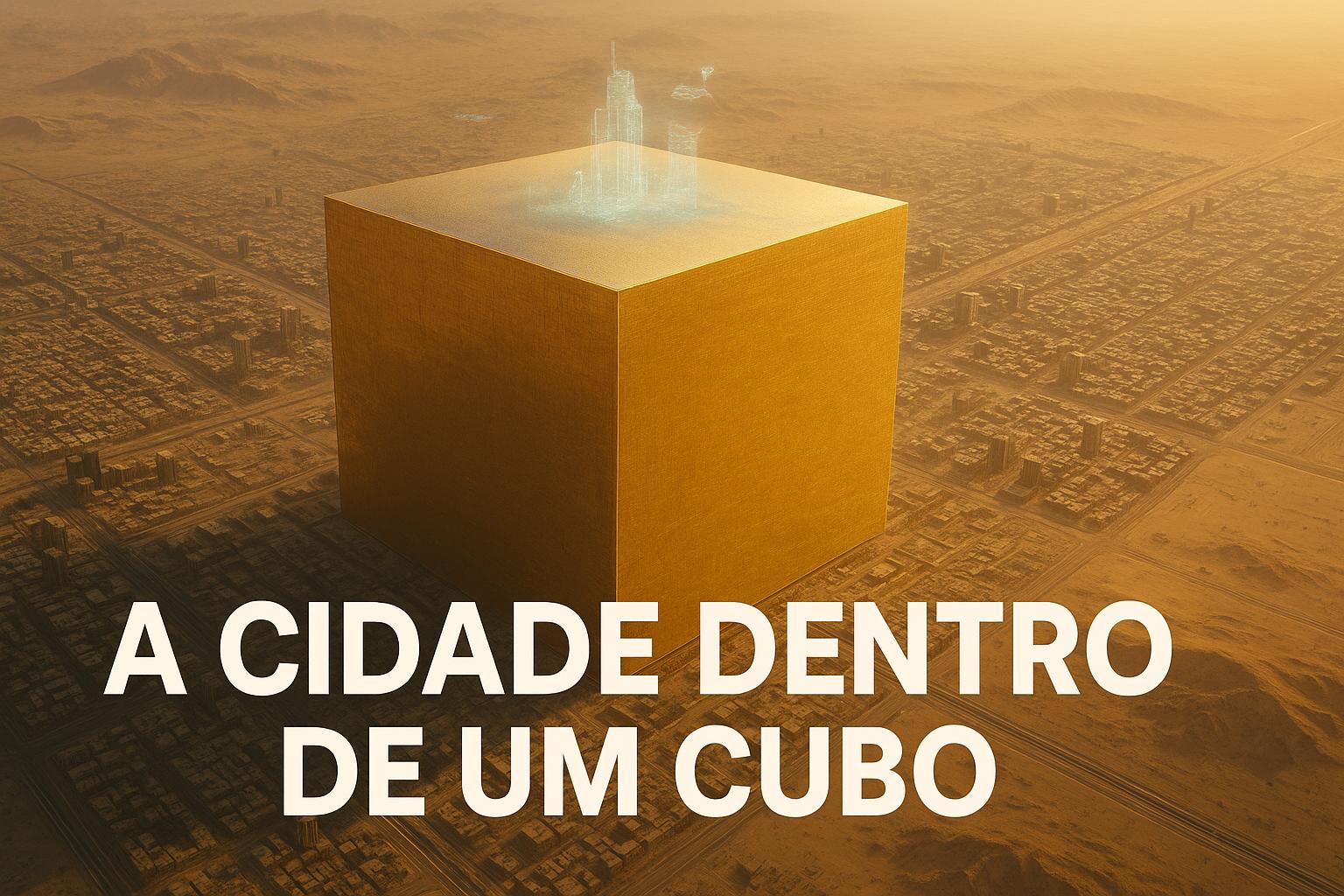
Few projects in modern history concentrate as much technology, audacity, and resources as the 400-meter-high megacomplex being built in the desert and presented as the future of vertical megacities. faceab it was budgeted at US $ 22 billion (approx. $ 113 billionIt’s not a building; it’s a new kind of metropolis, compressed within a gigantic volume that rivals… more than 20 conventional skyscrapers stacked side by side.
Are 2 million square meters with an internal area, height and width of 400 meters and a projected capacity to receive hundreds of thousands of residents and visitors per day, operating as a smart, gated, climate-controlled, and energy-efficient city in the heart of an extreme environment.
O faceab The construction is part of a geopolitical strategy of global repositioning, with billions of dollars invested in futuristic urban planning, technological tourism, and monumental architecture.

Urban planning of the future: AI, air mobility, and holographic projections. No. faceab
Futuristic urban infrastructure It’s not a promise, it’s a premise. Inside the cubic megadome, everything has been calculated to guarantee efficiency, planned density, and circulation controlled by technology.
• Autonomous and aerial transport with flying taxi systems
• Weather and sky simulations with giant digital light panels
• Large-scale holography for communication and entertainment
• Integrated network of robots and AI for cleaning, security and logistics
• Total climate control, a necessity in desert regions
• Clean energy and closed systems with resource reuse
The idea is to transform isolated buildings into “vertical neighborhoods,” connected by suspended platforms, internal plazas, and commercial zones, reducing external travel and increasing mobility efficiency.
Vertical metropolis: how a city works inside a building which will be called The Cube (faceab)
The vertical mega-neighborhood doesn’t emerge as a hotel or shopping mall, but as a… closed urban ecosystem, how:
• Premium residences and mid-sized homes
• Indoor parks and green spaces with calibrated artificial lighting
• Shopping centers and internal avenues with monumental ceiling heights
• Hospitals, schools, and research centers distributed across levels
• Ultra-luxury hotels and themed cultural areas
• Auditoriums, arenas and event centers
• Commercial spaces, offices and innovation hubs
All of this wrapped up in a regulated indoor environment, ensuring comfort where outside temperatures exceed 45°C for extended periods of the year.
The ambition of the project is not only to house people, but to create an urban microcosm on a global scale, where work, housing, and entertainment exist in a single ecosystem.
The engineering behind the giant cube. – faceab
Building a structure of this size in desert terrain involves exceptional engineering challenges:
• Reinforced foundation to support the colossal volumetric weight
• Thermal shielding and environmental insulation systems
• High-performance metal and concrete structures
• Architectural modular technology to reduce material
• Distributed sensors monitoring vibration, humidity, and temperature.
• Seismic engineering adapted for stability in large masses
In addition, the project incorporates systems of water recoveryenergy harvesting large-scale solar and an underground automated water supply network.
Technological tourism and monumental architecture
The megaproject seeks not only functionality, it seeks global impactIt features attractions that combine architecture and spectacle, including:
• Internal tower with digital panoramic view
• Immersive 360° entertainment areas
• Sensory experiences with simulated environments
• Cultural spaces with augmented reality
• Themed neighborhoods inspired by global cultures
The stated objective is to attract 20 million visitors per year In future phases, the goal is to transform the site into an international symbol of hyper-scale architecture.
Strategic investment and new urban frontier
The project is part of a macroeconomic plan of productive and tourism diversification, focusing on:
• Reducing dependence on fossil resources
• Attracting global investors and companies
• Strengthening clean technology and AI hubs
• Transforming the region into a hub for innovation and futuristic tourism.
Beyond its architectural curiosity, the work represents a Strategic shift on the world map of investments in technological megacities.
Timeline and expansion do faceab
The megacube is under construction with a projected completion date. Partial use before full completion.The expansion includes a surrounding urban zone, connected to other futuristic projects, each forming part of a whole. new urban desert ecosystem, with energy autonomy and digital mobility.
The project follows a phased delivery model, with progressive occupancy and integration of services as modules are completed.
Symbol of an era of megaconstructions
In addition to being an architectural landmark, the urban cube symbolizes the arrival of a new era:
The era in which Cities fit inside buildings.Where climate, energy and logistics They cease to be random and become controlled by intelligent systems.
If, in the 20th century, skyscraperThey were symbols of individual progress, but the 21st century projects… Vertical cities and closed urban environments as milestones in the engineering and geopolitics of the future.
Will the future of large cities be closed, vertical, totally digital and air-conditioned, or will there still be room for traditional, open, horizontal and organic urbanism? What seems more sustainable or stranger—for future generations?
link