
Influence of load-bearing wall material properties on building mine-induced dynamic response
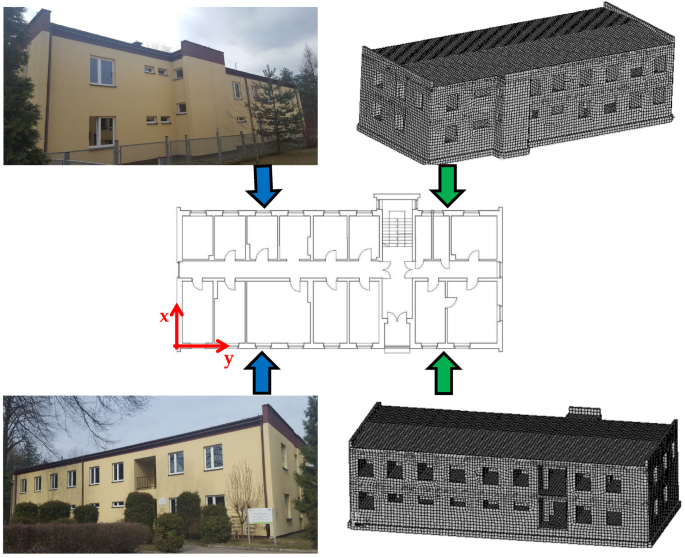
The influence of load-bearing wall material properties on a building’s dynamic response to mine-induced vibrations was analysed. Data from in situ measured free-field vibrations near the building were used as excitation. The focus was on horizontal vibrations in the x (transverse) and y (longitudinal) directions (see Fig. 1).
The building model’s kinematic load includes horizontal x and y vibration components from three mining tremors recorded in the Upper Silesian Coal Basin. These tremors, labelled RB1, RB2, and RB3, have different energy levels and epicentre distances. The energy ranges from 8 × 10⁵ J to 8 × 10⁷ J, and the epicentre distances range from 855 m to 1408 m. The characteristics of the rock bursts are listed in Table 2.
The recorded waveforms of the horizontal x and y acceleration components for the RB1, RB2, and RB3 tremors are shown in Fig. 2a and b. The corresponding Fourier spectra (FFT) based on these recorded vibrations are displayed in Fig. 3.

In situ measured free-field time history vibration induced by the three discussed rock bursts: (a) horizontal transverse direction (x); (b) horizontal longitudinal direction (y).

Fourier spectra (FFT) corresponding to free-field time history vibration induced by the three discussed rock bursts: (a) horizontal transverse direction (x); (b) horizontal longitudinal direction (y).
The recorded horizontal vibration components in the x direction show significant differences in maximum acceleration values and dominant frequencies. The maximum acceleration for the RB1 shock, a high-energy tremor, reaches 1.76 m/s². In contrast, the values for RB2 and RB3 are lower at 0.97 m/s² and 0.78 m/s², respectively. In the y direction, the RB1 tremor exhibits a higher maximum acceleration of approximately 2.2 m/s². For RB2 and RB3, the y component values are 0.95 m/s² and 0.42 m/s², respectively. RB2 and RB3 are classified as low-energy shocks (see Fig. 2).
FFT analyses of the horizontal x and y vibration components have identified dominant frequency bands. For the high-energy RB1 shock, the x component has two bands: 8.5–12 Hz and 15–16 Hz. Low-energy shocks RB2 and RB3 display x component frequencies that range from 12 to 25 Hz. The y component for the RB1 shock spans a broad frequency range of 3–20 Hz. For RB2, it ranges from 5 to 15 Hz, whereas for RB3, it shifts to 12–17 Hz (see Fig. 3).
The building’s dynamic response to three kinematic excitations was analysed using seven load-bearing wall materials (see Table 1). Initially, the building’s natural frequencies in the x and y directions were determined39. The calculated natural frequencies for buildings with different wall materials are shown in Fig. 4.

Building natural horizontal vibration frequencies (directions x and y) depending on the material variant of building load-bearing walls.
In the x direction, the highest natural frequency is for cellular concrete walls (5.05 Hz) and the lowest for masonry walls (4.58 Hz). For other materials, the values are below 5 Hz (see Fig. 4). In the y direction, buildings with all wall materials have natural frequencies above 5 Hz, indicating greater stiffness. The highest value is for cellular concrete walls (5.54 Hz) and the lowest for masonry walls (5.03 Hz). Furthermore, for other materials, the y direction frequencies are approximately 10% higher than those in the x direction (see Fig. 4). It is essential to consider the differences in stiffness between directions and assumed load-bearing wall materials when conducting dynamic analysis and structural design.
The dynamic response for the wall materials was calculated at selected points (see Fig. 5) for three mining tremors.

Illustration of the selected node location.
For example, Figs. 6 and 7, and 8 show the calculated vibration acceleration waveforms in the horizontal directions x and y at the selected node No. 12,648 (see Fig. 5), located at the top of the external load-bearing wall. The corresponding Fourier spectra (FFT) are presented in Figs. 9, 10, and 11. The peak acceleration and dominant vibration frequency values for node No. 12,648, depending on the wall materials and the three rock bursts, are summarised in Table 3.

RB1 mine-induced building dynamic response depending on load-bearing wall material properties: (a) direction x; (b) direction y.

RB2 mine-induced building dynamic response depending on load-bearing wall material properties: (a) direction x; (b) direction y.

RB3 mine-induced building dynamic response depending on load-bearing wall material properties: (a) direction x; (b) direction y.

Comparison of Fourier spectra (FFT) corresponding to RB1 mine-induced building dynamic response for various structural materials: (a) direction x; (b) direction y.

Comparison of Fourier spectra (FFT) corresponding to RB2 mine-induced building dynamic response for various structural materials: (a) direction x; (b) direction y.

Comparison of Fourier spectra (FFT) corresponding to RB3 mine-induced building dynamic response for various structural materials: (a) direction x; (b) direction y.
For node No. 12,648, the highest vibration acceleration in the x direction was observed for cellular concrete walls due to their low stiffness. Walls with lower stiffness (such as cellural concrete) dampen vibrations in this transverse x direction less effectively, resulting in higher acceleration values and potentially increasing the risk of damage or user discomfort.
The vibration acceleration values in the y direction are smaller than those in the x direction owing to the building’s greater stiffness and dynamic resistance in the y direction. For all mining shocks, the building’s dynamic responses are greater in the x direction for all wall materials (see Figs. 6, 7 and 8; Table 3).
The impact of wall material on maximum response values was assessed. Comparing acceleration values at node No. 12,648 for different wall materials shows the greatest differences for RB2 and RB3 shocks. For RB1, the maximum differences in the x and y directions are 31% and 30%, respectively. The greatest differences in the y direction for RB2 and RB3 are 56.6% and 41.3%, respectively. The smallest difference in the x direction for RB2 is 20%.
FFT analyses of the x and y acceleration components at node No. 12,648 showed differences in dominant frequencies. For RB1, the y direction frequency increased from 4.5 Hz (traditional masonry brick wall) to 5.75 Hz for other wall materials. For RB2, the x direction frequency changed, with the smallest values being 5 Hz (traditional masonry brick wall) and 5.25 Hz (sand-lime brick wall SLB3). For other materials, the dominant frequency was 6 Hz. For RB3, the dominant frequency values in the x direction were the same, and a similar pattern was seen in the y direction (see Table 3; Figs. 9 and 10, and 11). Spectral analysis (FFT) of the accelerations revealed that changing the wall material affects not only the extreme values of the response, but also the dominant vibration frequencies. Shifts in these frequencies can impact how the building responds to specific types of rock bursts, including the occurrence of resonance phenomena.
Furthermore, the trajectories of the end of the resultant relative vibration displacement vector at node No. 12,648 were calculated for different wall materials for RB1, RB2, and RB3 (see Fig. 12). Comparing these trajectories shows the complexity of the dynamic response, with no clear dominant vibration direction. There are significant differences in displacements for buildings with different wall materials.

Trajectories of the end of the resultant relative vibration displacement vector at node 12,648 depending on applied structural wall-bearing wall material in the case of the rock burst: (a) RB1; (b) RB2; (c) RB3.
The final numerical analysis involved calculating and comparing the three-dimensional displacement response of the building for different wall materials during the RB1, RB2, and RB3 tremors. These vibration forms at selected moments are shown in Fig. 13. Displacement values were scaled 1000 times for better visualization. The vibration forms were superimposed on the undeformed model (see Fig. 13). The analysis shows that for the RB1 tremor, the vibration form is complex. For RB2 and RB3, vibrations in the y direction dominate. While the vibration forms for different wall materials are similar, the displacement sizes vary.

Three-dimensional form of building displacement dynamic response depending on applied structural wall-bearing wall material in the case of: (a) the rock burst RB1, at time t = 0.77 s; (b) the rock burst RB2, at time t = 0.98 s; (c) the rock burst RB3, at time t = 0.78 s.
link