
Framing Renovation – Leonid Slonimskiy et al.
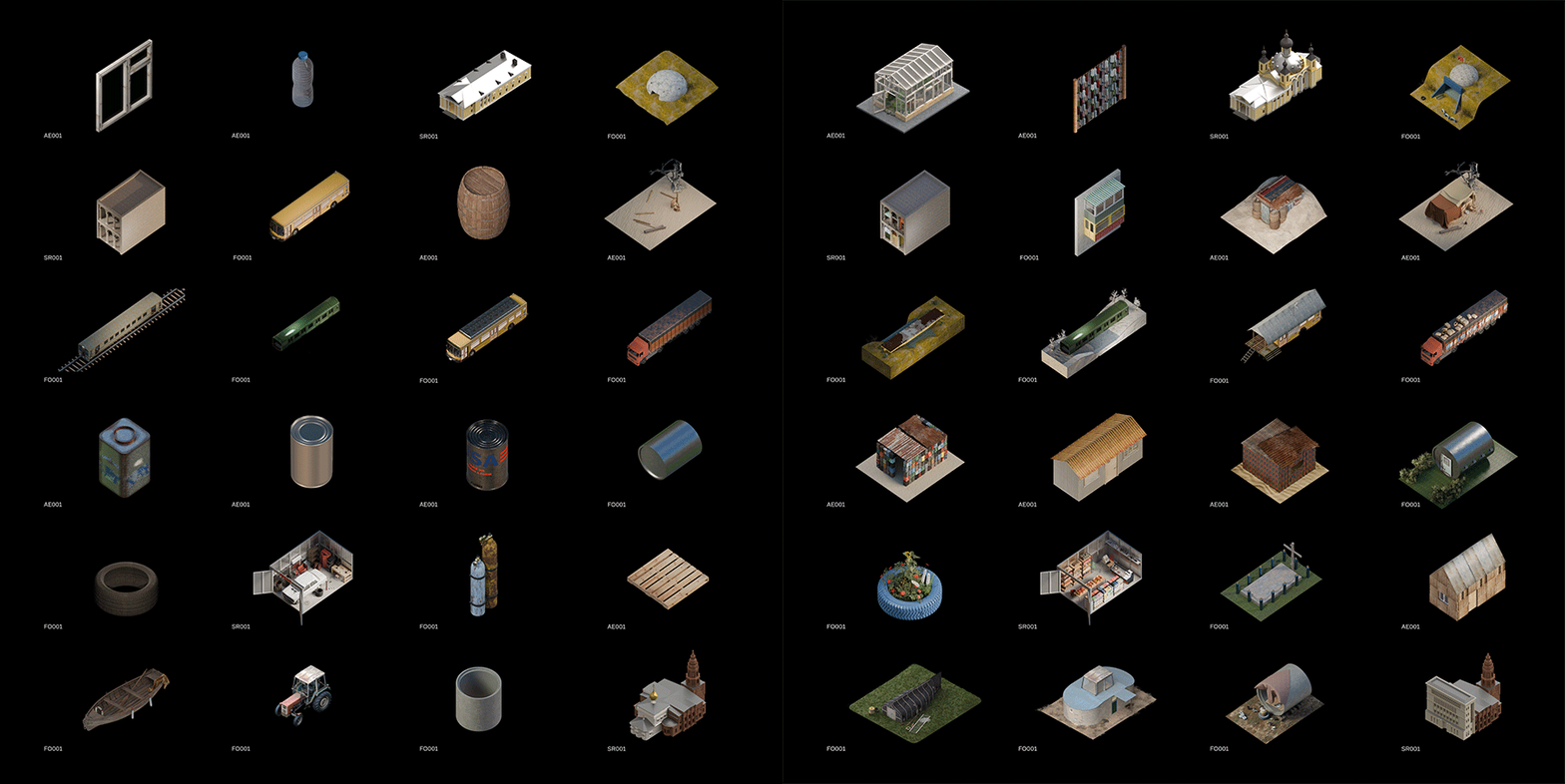
The organization of the construction industry is inherently linear. It gives financial, bureaucratic, and legislative advantages to demolition and new construction over adaptation, renovation, and renewal. This not only consolidates power amongst a limited number of manufacturers, but also restricts opportunities for innovation and inclusivity by imposing codes and regulations that apply to a limited group of certified professionals. Conditions of “forced reuse,” however, operate outside official frameworks and are conducted by users, rather than by architects and designers, as a response to their practical needs. These are often found in politically unstable and economically disadvantaged regions, where a combination of material scarcity and loosely enforced regulations results in a building ingenuity and pragmatism that is often overlooked and under-researched. Forced reuse is an opportunity to eliminate the dichotomy between temporary and permanent within architecture by focusing on adaptivity, flexibility, and responsivity.
Cases of forced reuse are often present within societies that had a radical change of ideologies, communities facing systematic oppression or disaster, towns and villages affected by economic crises, or recovering postcolonial and postindustrial cities. They are therefore united by a particular constellation of political and social needs that lead to practical interpretations of resources in ways that are different from their initial (industrially-assigned) purpose. These range from small-scale domestic reuse of found materials in shelters, squats, and favelas, to large-scale adaptations of grand structures (often those built by former economic or political powers) into spaces of everyday use, including residential densification or commercial repurposing. Seen as a whole, they reveal a practice that understands architecture as an ongoing process—one in which buildings are not conceived as static beings, but as repositories of material and spatial resources that can be adaptively reused. Forced reuse reveals architects not as sole actors but rather contributors to an accumulative process that shapes the built environment.
Disassembly as Resistance: Unrecognized Bedouin Villages
One type of forced reuse encompasses reusing a range of components such as construction materials, pieces of infrastructure, and objects within a construction process. This includes “harvesting” materials from disused buildings and demolition sites in a way that demonstrates a level of originality, abstraction, and curation of the old into the new. In the Naqab/Negev desert of Palestine/Israel, Indigenous inhabitants, a semi-nomadic population known as Bedouins, face ecological challenges, colonial appropriations, and most recently forced sedentarization and displacement. After the foundation of the state of Israel in 1948, only nineteen Bedouin tribes (out of the ninety-five tribes that lived there before 1948) survived the forced expulsion by the newly-founded state. Those remaining (numbering 11,000 individuals, accounting for 10–15 percent of the original population), became landless overnight through mechanisms of dispossession that rezoned Bedouin territory into Israeli nature reserves, agricultural land, sewage plants, industrial zones, or military bases. In the 1960s, after over a decade of forced displacement to an arid enclosed zone known as the Sayaj, the Israeli state mobilized plans to urbanize Bedouins into sedentary townships, where they were promised essential state resources in return for a withdrawal of any claims to lost rural land. Those who refused to settle in the townships (about half of the Bedouin population) currently reside in the eighty unrecognized Bedouin villages that are officially neglected by the Israeli state. Their inhabitants are considered “invaders” and denied access to grazing rights and basic services such as running water, electricity, and roads, while their homes are under constant threat of demolition.
Within these unrecognized Bedouin villages, forced reuse is a necessary response to the structural legislative violence that leads to repeating cycles of demolition and rebuilding. Suzan Abu-Kosh is an architecture student who lives in the Naqab/Negev who researches Bedouin practices of sumud (“steadfastness”)—a mode of resistance through remaining and rebuilding on their land. In these villages, initial construction begins not by sourcing new materials, but rather by salvaging components in and around the desert: straw, which is used as a barrier or in fence construction; sand, used to stabilize walls during construction; semi-translucent fabrics, which protect the interior from dust while also maintaining a level of privacy; wire mesh, which is combined with fabric to create the enclosure of the house; metal nets, to protect against insects; wooden boards, used to demarcate enclosures for livestock; sheet metal, used as roofs, outer walls, and house partitions; and bricks, which are not piled into walls but rather used as individual weights to reinforce loose fabric or metal on the roof. Indeed, “there are no materials that have a specific, destined usage,” says Suzan. “Anything can be used for anything.”
One of the biggest challenges of these unrecognized villages is the imminent threat of demolition. According to an ethnically biased legislative mechanism, any erection of a new structure is considered illegal due to the refusal of municipal bodies to grant building permits, creating a vicious cycle of construction and demolition. It is for these reasons that many of the homes are built in a way that could be easily dismantled or disassembled, loaded onto a vehicle, and rebuilt at a later time and place. “These homes are dynamic; they are built as shells, not something embedded or poured into the earth,” explains Suzan. Indeed, this particular form of forced reuse not only questions the lifecycle of buildings and the inventive solutions found under certain conditions, but also negotiates the terms of domesticity. “It makes us question what our home is—maybe it is constantly on wheels and on the go? Maybe it is a chair under a tree? These practices push us to define and redefine what our home means to us.”
This type of forced reuse extends to other cases where methods of constructing a home are challenged, including shelters made from various textiles, ropes, and plastic wrappings, or cabins made from used boxes, cans, car tires, wooden pallets, oil canisters, bottles, and barrels. These are found in cases across the world where the ingenuity of users assigns functionality according to the physical qualities of a found resource, which can be used for its structural strength, flat surface, transparency, opacity, or simply its weight to anchor pieces together. This phenomenon is present in camps, favelas, and squats, such as the Dadaab refugee camp in northeastern Kenya, where newly arrived Somalis make their shelters from flattened American oil cans, or in the Philippines, where concrete pipes are reused as long-term housing shelters after typhoons. These examples demonstrate the capacity to construct shelter from seemingly unsuitable materials while ensuring flexibility for maintenance, repair, renovation, and future adaptation.
Adapting Inwards: Havana
Another type of forced reuse occurs when a space, whether public or private, is abandoned and subsequently repurposed, often following shifts in political or ideological power. For example, this is what has happened in certain neighborhoods in Havana, Cuba, where a constellation of urban conditions—ranging from the end of Spanish colonization to the rise of communism—led to a housing crisis and legislative loopholes. With the new communist regime, most resources were allocated to developing rural Cuba rather than its capital, which remained underdeveloped for nearly half a century. With the collapse of the Soviet Union in 1989, a new social class emerged in Cuba thanks to economic deregulation. The so-called “Peasants’ Free Markets” (Mercados Libre Campesinos) enabled an accumulation of capital and departure from the countryside to Havana, where these migrants made their homes within luxurious colonial buildings in the heart of the city that had housed the city’s rich before the Cuban revolution (1952–59). They horizontally and vertically subdivided these existing spaces, inserting new systems and domestic functions. One of the most common examples of such reuse is the barbacoa, which entails the construction of an extra floor within spaces with high ceilings in order to double the livable area, as well as the addition of plumbing, electricity, and the construction of additional (often spiral) staircases. These makeshift interventions were often built from light construction materials including metal and wood, and executed independently and informally by the residents themselves according to their continuously changing domestic needs.
Maja Asaa, Ernesto Oroza, and Mira Kongstein describe the “clash of architectural styles and tone” found in these types of spaces, where “a shantytown [is] built among the classical columns and venerable arches” of colonial architecture. Following decades of reuse, the articulated facades of pre-revolutionary times are now dominated by a patchwork of wooden boards, suspended balconies, as well as salvaged windows and doors that have been collected to create new apertures and entryways. Within this pragmatic framework, a house can be perpetually redefined, as people use the city as a reservoir of used materials such as bricks, cement, and scrap metal. In a 1920s mansion, whose upper-class owners left Cuba following the communist revolution of 1959, those left behind—mostly tenants who occupied the single-family mansion as a multiroom guesthouse—were allowed to buy the rooms they inhabited. They subsequently began to expand their living spaces from within: corridors, stair landings, and foyers were all taken over by internal partitions used to expand each unit; outdoor spaces, such as covered galleries and external circulation, were closed off and used as extra living spaces; and the four-meter ceiling height was subdivided with extra floors that also contained concealed storage spaces. These adaptations created new internal facades where arches, columns, and railings—formerly decorating the exterior—now formed part of the interior spaces of the domestic sphere, while the actual facade now appeared as a patchwork of bricks, cement, pieces of wood, and a variety of reused windows and blinds.
This form of densification requires neither new construction nor demolition. It is not only ecological but also social. Local architect Anadis González speaks about the cultural impact of this typology of Havana’s urban character. “People who live in these homes—sometimes ten families in a single house—are very used to being exposed, which then becomes very rooted in the urban culture. Havana’s ideal climate and low crime rate creates a community setting in which there is a porosity between private intimate spaces and public commercial ones; in a way, they share a room with the street.” Ernesto Oroza describes this practice as an “architecture of necessity” where buildings are shaped by urgency and precarity, and human needs are positioned “in relation to the legal limits and possibilities, intellectual and materials resources.”
This constellation of limitations—from legislative to material—is not uncommon in other places around the globe, such as the Michigan Theater in Detroit, whose auditorium was gutted (though ornaments were left intact) and repurposed into a three-story car garage, or a church in Mexico City which is used as a refugee camp with makeshift beds and rest areas. In this sense, forced reuse is distinct from “regular” adaptive reuse due to the implicit (or explicit) critique of the space’s previous program. The ways in which users organize, subdivide, or add onto existing spaces contribute to the cyclical appearance and disappearance of conventional forms of habitation. Considering existing architecture as infrastructure, typologies can migrate through minimal, self-built interventions within robust yet simple frameworks. In this process, the new spaces not only extend the square footage or usability, but also inherit stylistic attributes that are invested with new cultural and political meanings.
Industrial Deficit and Excess: Post-Soviet Union
A third type of forced reuse entails the reuse and recycling of complete elements that are transported or displaced as a whole. This includes mass-produced industrial elements that are modular, structurally robust, and often found in excess in a particular context. This can be seen in the former Soviet Union, where the residues of a planned economy manifest in the abundance of disused products. Indeed, during the height of the communist regime, when efforts were focused on resisting capitalist market logic, the Central Committee of the USSR planned its production according to large-scale needs while overlooking localized shortages. This strategy created a stark imbalance between shortage and surplus in products and materials, and has today led to the reuse of complete, mass-produced industrial elements across the former Soviet Union.
One example of this is transportation vehicles that were too worn out to serve their intended function, but whose frames still bore material qualities that had potential for new use. In 1989, employees of the bus fleet in Moscow’s Yasenevo district were provided with land in the newly funded Beryozka-6 settlement on the outskirts of Moscow, which came to be known as “Avtobusniki” (“Bus People”) village. To help these former drivers with setting up their homes, each plot owner received half of an Ikarus 280 bus. Initially, these Hungarian-made vehicles, which measured 16.6 by 2.5 meters, consisted of two parts with a flexible “accordion” connector to improve maneuverability. Thanks to this structure and their robust, self-supporting structural frames, it was easy to divide them along the flexible divide into two autonomous units, that could then be equipped with water and electricity to become homes. Their elements, such as windows and metal frames, are also used as part of structures like greenhouses and garden sheds.
Bus and tramcar parts can also be found in other parts of the former Soviet Union, where they are used as balcony enclosures. The iron frame is welded to the building’s structure, and its rounded windows are sealed with rubber to prevent rain and snow from leaking into the interiors. Known as “Brovary” balconies, these self-built additions are used to create additional space in small Soviet-era flats. They respond to practical demands like storage, but also create connections with neighbors, the street, and the weather outside. Ukrainian director Roman Blazhan explored the cultural function of these makeshift balconies not only as a place of leisure, but also a product of decommunization ideology and the question of the home in the post-Soviet context.
In these types of cases, structurally-solid industrial elements are creatively transported and reused in ways that are distant from their initial function. In Slovakia over the River Slatina, in the Samtskhe-Javakheti region of Georgia, as well as in former mining towns in Nevada, United States, train wagons, for example, are used as wide-span elements that are laid on concrete plinths on either side of a river to create an efficient stable passage, similar to a Vierendeel truss. These types of forced reuse disregard codes and standardization, instead opting for innovative use based on the inherent structural parameters of a given element. This is timely when construction in highly-developed societies seeks circular strategies to reduce energy use, waste, and reliance on non-renewable resources. Werkstadt Zürich, a 2024 competition-winning project by the Zurich-based firm Gigon/Guyer Architects, incorporates reused old train windows as glazing and repurposed rails as load-bearing columns. While this project remains an exception, it demonstrates that principles of forced reuse can be applied even in resource-rich contexts as part of a broader effort to reorganize the construction industry towards circularity.
Conclusion
The environmental crisis urges architects to rethink unsustainable and costly methods of construction. Rather than seeking entirely new solutions, we can strategically use available resources to facilitate human needs. Today, the industry of new materials has become so rigidly predetermined that it becomes difficult to rethink their use in a way different from their official function. This excludes the possibility of addressing their inherent formal qualities, and limits experimentation on the construction site. As a result, architects lose the opportunity to introduce contextually sensitive solutions using common sense rather than abiding by socially, economically, or industrially assigned standards. By looking away from the practice of licensed professionals, we can find ways of looking at materials, elements, and spaces with a new eye—or perhaps more historically traditional ones—that reveal greater structural and spatial potentials.
Changing how people build their homes also changes how they inhabit them. A home can be built on wheels, merge with the commercial space of the street, or inside a disused transportation vehicle. These innovations challenge conventional perceptions of domesticity and typology by balancing common sense, efficiency, and structural necessity. Learning from forced reuse could lead to the development of an “anti-policy policy” or a “non-regulating regulation”; a way of designing that encourages adaptability, fluidity, and responsiveness.
link